
CU-care
A patch worn on the upper back for people with cholinergic urticaria, the hives that heat and sweat set off. One block cools the skin and helps the wearer calm down during a flare-up. The other uses gentle heat to build tolerance between flare-ups. A phone app runs both.
Why this one
I've never been diagnosed, but I know a mild version of the feeling. In winter, spicy food or getting worked up can make my whole body prickle like it's full of needles, though I don't get the rash. Cholinergic urticaria is the full version: hives set off by a rise in body temperature, from exercise, sweat or heat.
Two people who live with it
I interviewed two people with the condition about when it starts and what they do about it.
Jack
Student, 18
"Every time it's winter, it's the most challenging period for me. This condition flares up when I exercise in the cold, and I feel like my whole body is being pricked by needles."
- Relief: a wet towel behind the neck, which works less over time.
- Recovery: about 2 liters of hot water a day to keep body temperature up, for a mild desensitizing effect.
Zion
Designer, 26
"I developed urticaria symptoms a decade ago. After about three years of treatment, I've largely recovered."
- Flare-up: stand outside in the winter wind until the itching fades.
- Prevention: running for a good sweat. After a couple of uncomfortable sessions it gets much better.
Winter came up in both. People wear layers to stay warm, so even light activity raises body temperature, and the dry cold means less chance to sweat and get used to it.
Both of them needed two different things: relief in the moment, and a slower way to become less sensitive. That split became the two blocks.
Why the back
I compared skin temperature at five spots. The back read highest. Many blood vessels run through this area, and as the body's core temperature region it is the best place for both cooling and warming.

Two blocks

Relief
During a flare-up
A temperature sensor reads the skin surface and a GSR sensor reads sweat on the skin. Past a set value, the fan and cooling fin switch on. When the GSR reading shows the wearer getting worked up, the vibration motor gives the skin a second signal to attend to, based on gate control theory.
Temperature sensor, GSR sensor, fan, cooling fin, vibration motor, Bluetooth, battery, Arduino Uno

Recover
Between flare-ups
Desensitization with gentle heat, so the skin gets used to warmth on the wearer's terms. The wearer switches the heat on from the phone over Bluetooth. It holds a constant temperature, runs on a countdown, and shuts off above a tolerable level. Regular vibrations also pace a short meditation.
Heating element, GSR sensor, vibration motor, fan, Bluetooth, battery
Breadboard prototypes, tested on the hand
Finding the shape

1Sketch and sizes

2Foam blocks to test size

33D printed shell

Left and right hand reach
Before choosing a form, I tested where on the back each hand can reach, so people could put the device on by themselves.
Three ways to wear it

1. Sport strap
Good
- Sporty
- Not prone to falling off
Bad
- Uncomfortable
- Not suitable for long wear
- Poor privacy

2. Breathable patch
Good
- Convenient to wear
- Disposable
- Privacy
Bad
- Not designed for heavy loads

3. Butterfly patchChosen
Good
- Convenient to wear
- Disposable
- Privacy
- Not prone to falling off
Bad
- Not designed for heavy loads
The patch and the app

Disposable transparent patch with a block seated
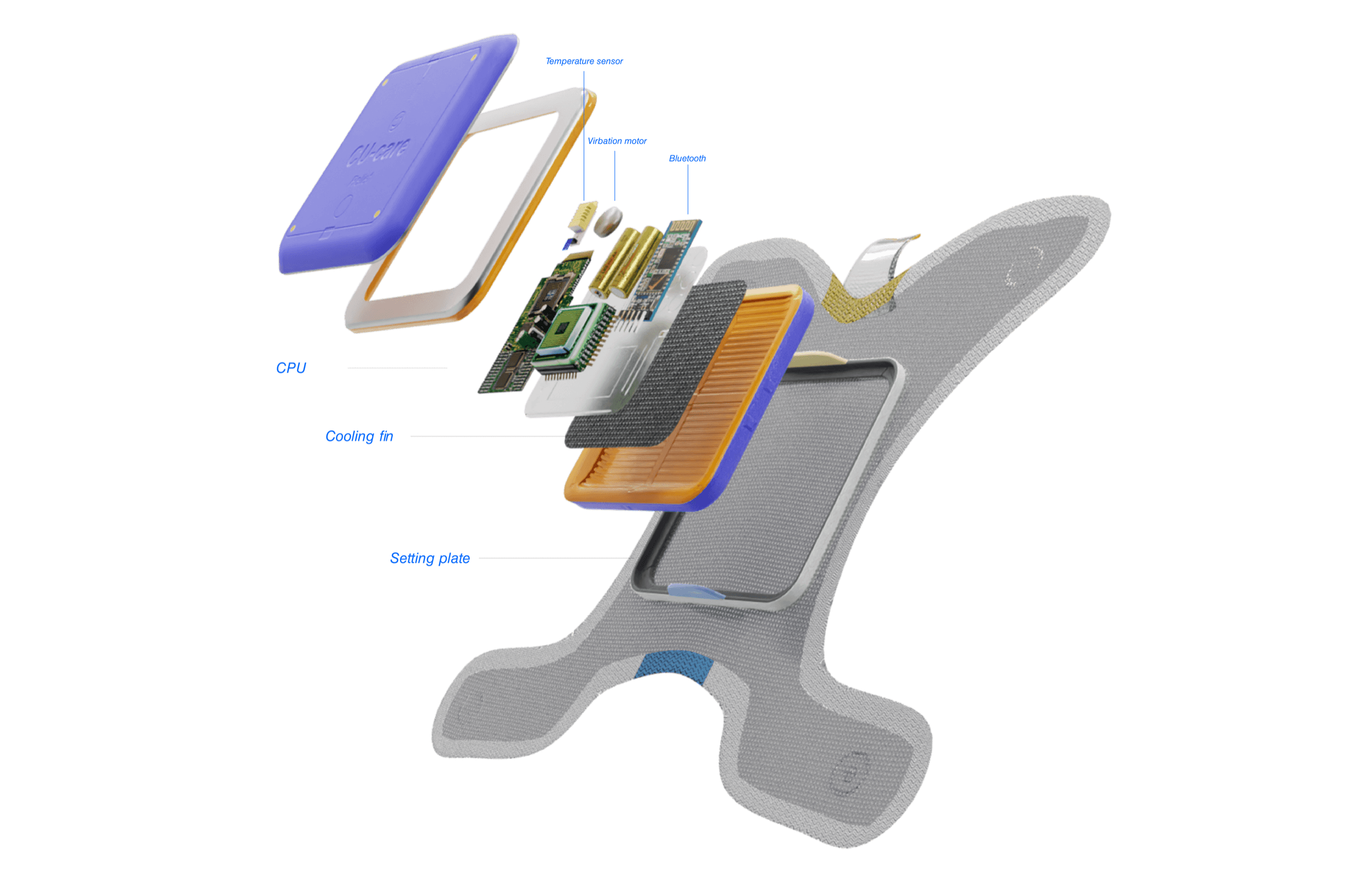
- 1Temperature sensor
- 2Vibration motor
- 3Bluetooth
- 4CPU
- 5Cooling fin
- 6Setting plate
- 7Disposable transparent patch
Eight screens
The app pairs with a block over Bluetooth, shows readings over time, runs the meditation and heat training, and gives small rewards for keeping up the routine.


Putting it on

- 1Pick up a disposable placement sticker.
- 2Load the modules you need. The stickers are marked so they only go one way: yellow for top, blue for bottom.
- 3Peel off the protective layer.
- 4Use the tab to press it onto the back.
The prototype, worn
A two-minute user's guide made with the printed prototype: connecting a block, putting the patch on, and wearing it under a jacket.

The butterfly shape follows the back muscles and stays put during exercise.

It disappears under a jacket.
Looking back
Cu-Care is a design concept. Next step: review the heat and cooling settings with a clinician, and define who can see the GSR and temperature data.